Zyphora Zyphora

What Is an AI Computing Server Manufacturer?

Time:2026-10-13 Author:Madeline
0%

An ai computing server manufacturer designs and builds systems for demanding artificial intelligence workloads. These systems combine accelerators, processors, memory, networking, storage, cooling, and management software. A conventional server may prioritize general business applications. An AI server must move enormous datasets quickly and maintain stable performance under sustained thermal pressure.

The market is expanding rapidly. IDC’s Worldwide AI and Generative AI Spending Guide has projected strong growth in AI infrastructure investment through the decade, driven by model training, inference, and enterprise automation. Gartner has also identified AI-optimized servers as a major part of expanding data-center hardware demand. These reports indicate opportunity, but they do not make every supplier equally capable. Engineering depth matters.

Look closely at the details. A serious manufacturer validates GPU compatibility, power delivery, airflow, firmware, and remote monitoring before shipment. It should also publish measurable performance results, warranty terms, and service response procedures. Uptime Institute research repeatedly shows that power, cooling, and human error remain central data-center risks. That reality makes rack design as important as processor selection.

The boundary is not always clean. Some companies manufacture complete servers, while others integrate components from established technology vendors. A reliable evaluation should examine design ownership, testing standards, supply-chain transparency, and post-sales support. The best choice is not necessarily the system with the most accelerators. It may be the one that runs consistently, scales responsibly, and remains serviceable after deployment. That distinction matters.
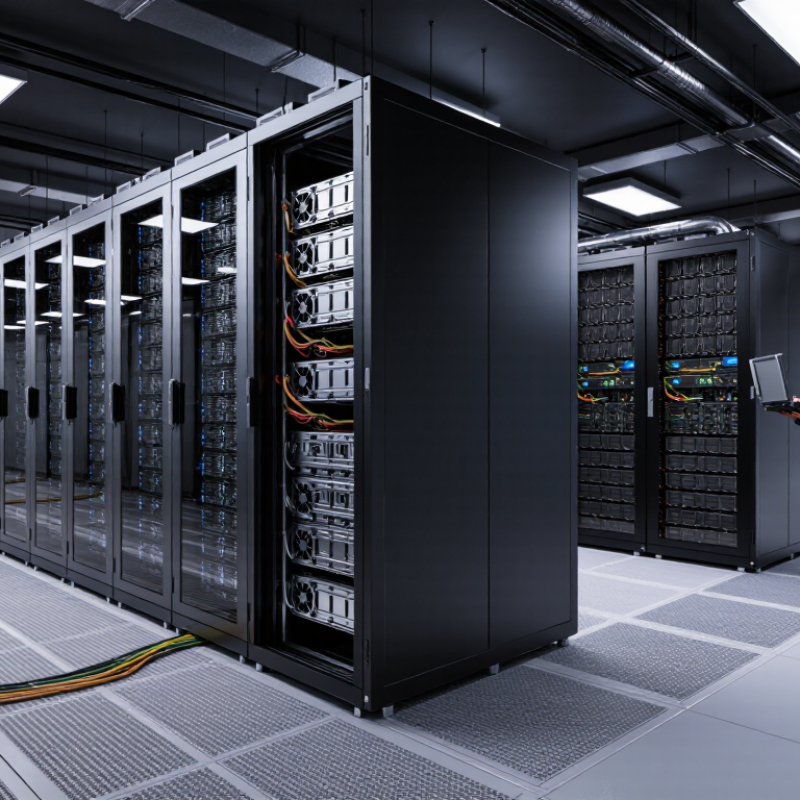
What Is an AI Computing Server Manufacturer?

Definition and Role of an AI Computing Server Manufacturer

What Is an AI Computing Server Manufacturer?

Definition and Role of an AI Computing Server Manufacturer

An AI computing server manufacturer designs and builds specialized systems for artificial intelligence workloads. Its role extends beyond assembling processors, memory, storage, and network cards. The manufacturer studies how models train, infer, and move data across hardware. A practical system may include multiple accelerators, high-speed interconnects, redundant power supplies, and liquid cooling. These choices affect speed, energy use, and service life. In other words, the manufacturer turns complex computing requirements into a deployable machine. This is the core definition.

A reliable manufacturer validates each server under realistic conditions. Engineers may run image classification, language processing, or simulation workloads while monitoring temperature, latency, and power draw. They also check firmware, driver compatibility, rack dimensions, and remote management functions. Documentation matters. Clear installation steps and failure procedures help operations teams respond at 2 a.m. Support should include diagnostics, replacement planning, and security updates. Experience is visible in these details, not in impressive specifications alone. Claims should be measured against repeatable tests.

The role can also involve system design advice. A manufacturer may recommend different configurations for model training, real-time inference, or private data processing. However, recommendations are not always perfect. Workloads change, budgets tighten, and cooling assumptions can fail in a crowded data center. Honest providers disclose limitations and revise designs after field feedback. Customers should ask for test results, power estimates, warranty terms, and upgrade paths. A server is not merely a metal enclosure. It is an operational commitment.

Core Technologies Used in AI Computing Servers

What Is an AI Computing Server Manufacturer?

An AI computing server manufacturer designs systems for training and deploying machine-learning models. Its work extends beyond assembling processors. It combines accelerators, high-bandwidth memory, fast storage, networking, power delivery, and thermal controls.

Memory matters. During model training, data moves repeatedly between processors and memory. Slow movement can waste expensive compute capacity.

Modern servers increasingly depend on high-speed interconnects, such as PCIe and advanced fabric networks, to link multiple accelerators. Distributed training also requires synchronized data exchange. Stanford University’s AI Index 2025 reports that training compute has been doubling approximately every five months. This trend increases demand for scalable architectures, efficient software stacks, and reliable monitoring. A manufacturer must also validate performance through practical workloads, not only attractive laboratory numbers.

Heat is real. The International Energy Agency’s Energy and AI report estimates that data centers used about 415 terawatt-hours of electricity in 2024. It projects consumption could exceed 945 terawatt-hours by 2030. Liquid cooling, airflow design, and power-aware scheduling therefore become core technologies, rather than optional upgrades.

MLCommons’ MLPerf benchmarks help compare training and inference performance, but benchmark results do not represent every customer environment. A server may lead on throughput yet struggle with maintenance, noise, or uneven workloads. That gap deserves more attention. Reliable manufacturers document system limits, test failure recovery, and provide clear performance evidence before deployment.

How AI Computing Servers Are Designed and Produced

What Is an AI Computing Server Manufacturer?

How AI Computing Servers Are Designed and Produced

An AI computing server manufacturer turns demanding software workloads into dependable hardware systems. Engineers begin by studying model size, training speed, memory capacity, and expected user traffic. These requirements shape the server’s processor selection, accelerator layout, storage, and network design. Every decision affects heat, power use, serviceability, and cost.

Production starts with carefully engineered boards, high-speed memory, power modules, and cooling assemblies. Technicians install components inside reinforced racks with controlled airflow paths. Some systems use liquid cooling when dense workloads produce excessive heat. Sensors track temperature, voltage, fan speed, and power changes during operation. Thermal cameras can reveal hot spots that ordinary monitoring misses.

Small details matter.

Testing usually includes firmware checks, memory tests, network validation, and extended workload simulations. Engineers may run a server continuously for several days before shipment. They inspect cable routing, fastening pressure, vibration resistance, and emergency shutdown behavior. A reliable process records each result for later maintenance.

Still, design is not perfect.

A quieter cooling profile may reduce thermal headroom. Higher memory capacity can increase energy demand. Prototype testing sometimes exposes assumptions that looked reasonable on paper. Manufacturers must revise those assumptions before the system reaches a data center. That ongoing correction is part of responsible engineering.

Key Services Offered by AI Computing Server Manufacturers

What Is an AI Computing Server Manufacturer?

Key Services Offered by AI Computing Server Manufacturers

AI computing server manufacturers design and build systems for training, inference, simulation, and high-volume analytics. They combine accelerators, processors, memory, storage, and high-speed networking. Their role extends beyond assembly. IDC’s Worldwide AI and Generative AI Spending Guide projects global AI infrastructure spending will reach $235 billion by 2028.

Fit matters.

A capable manufacturer begins with workload assessment and hardware planning. It can recommend server density, memory capacity, network topology, and storage performance. It may also provide rack integration, firmware configuration, operating-system deployment, and compatibility testing. These services reduce setup errors, especially when several servers share one cluster. However, a specification can look complete and still miss a customer’s real data movement patterns.

Support continues after installation. Manufacturers often offer remote monitoring, preventive maintenance, spare-part planning, diagnostics, and workload optimization. They may tune cooling profiles and power limits to balance speed, noise, and operating cost. The International Energy Agency reports that data centers consumed about 460 terawatt-hours of electricity globally in 2022, with demand potentially exceeding 1,000 terawatt-hours by 2026.

Power matters too. Efficient airflow design, accurate load testing, and clear service-level procedures are therefore practical requirements, not decorative promises. Independent benchmark results can help, but they rarely predict every production environment. Details decide uptime.

Factors for Evaluating an AI Computing Server Manufacturer

An AI computing server manufacturer builds systems for demanding model training and inference. Evaluation should begin with measurable engineering, not attractive specifications. The 2024 AI Index Report notes that training compute for notable models has grown rapidly, roughly doubling every five months. This trend makes thermal control, power delivery, and upgrade paths practical concerns.

Review accelerator compatibility, memory capacity, network bandwidth, and storage latency. Ask for MLPerf results or comparable, independently verifiable benchmark records. Results should identify model size, batch settings, precision, and cooling conditions. Otherwise, comparisons may mislead. The International Energy Agency reported that data centers consumed about 460 terawatt-hours globally in 2022. Therefore, a manufacturer should provide power estimates, rack-density limits, and efficiency measurements. A server that performs well but overheats is not a reliable investment.

Tips: Request a sample configuration and calculate total ownership costs. Include electricity, maintenance, software support, replacement parts, and technician response time. Check whether firmware updates remain available after purchase. Speak with existing operators, if possible. Their experience may reveal noise, cable faults, or delayed repairs that brochures omit. I would also test failure recovery before signing a large contract. Perfect uptime claims deserve skepticism.

What Is an AI Computing Server Manufacturer? - Factors for Evaluating an AI Computing Server Manufacturer

An AI computing server manufacturer designs, integrates, validates, and supports servers optimized for artificial intelligence workloads such as model training, fine-tuning, inference, and high-performance data processing.

Evaluation Dimension What to Evaluate Key Technical Metrics Recommended Evidence Practical Benchmark or Requirement Suggested Weight
AI Hardware Design Capability Ability to design systems specifically for training, fine-tuning, and inference workloads rather than adapting general-purpose servers. Accelerator compatibility; PCIe or high-speed interconnect topology; GPU or accelerator density; CPU-to-accelerator balance; memory bandwidth. System architecture diagrams, validated configurations, workload-specific design documentation, and thermal design records. The proposed configuration should support the intended accelerator type, interconnect topology, operating system, and AI framework without unsupported modifications. 15%
Accelerator Integration Quality of integration for GPUs or other AI accelerators, including power delivery, cooling, firmware, and physical installation. Accelerator count per node; total board power support; slot spacing; auxiliary power connectors; peer-to-peer communication; firmware compatibility. Factory integration checklist, compatibility matrix, firmware validation records, and installation test results. Every accelerator should operate within its specified power and thermal limits under a sustained workload, with no cable, slot, or airflow conflicts. 14%
Computing Performance Measured performance on representative AI workloads, not only theoretical accelerator specifications. Training throughput; inference throughput; time to train; latency; scaling efficiency; performance per watt. Reproducible benchmark reports, workload configuration, software versions, batch size, precision mode, and power measurement method. Performance results should be reproducible using a documented test method and should reflect the customer’s models, data sizes, and precision requirements. 13%
Memory and Storage Architecture Suitability of system memory and storage for large datasets, model checkpoints, embeddings, and high-concurrency workloads. System RAM capacity; memory channels; storage capacity; sequential and random I/O; storage latency; local and shared storage compatibility. Memory population plan, storage performance tests, endurance specifications, RAID or data-protection design, and upgrade options. The configuration should prevent data-loading bottlenecks and provide sufficient capacity for the model, dataset, checkpoints, logs, and temporary files. 10%
Networking and Cluster Scalability Capability to connect multiple AI servers for distributed training, shared storage, and high-volume data movement. Network bandwidth; latency; topology; port density; RDMA support where required; multi-node scaling efficiency; congestion management. Network architecture, switch compatibility list, multi-node benchmark results, cabling plan, and cluster deployment documentation. The network design should match the required data-transfer pattern and maintain acceptable scaling efficiency as additional nodes are added. 10%
Thermal Management and Power Efficiency Ability to maintain stable performance during sustained AI workloads while controlling heat, noise, and energy consumption. Cooling method; inlet temperature range; sustained power draw; thermal throttling behavior; fan redundancy; performance per watt. Thermal test reports, airflow diagrams, power measurements, environmental specifications, and data-center rack requirements. The server should complete extended workload tests without thermal throttling and should fit the facility’s rack power, cooling, and airflow limits. 10%
Reliability and Availability Design quality and operational stability during continuous, high-load operation. Component redundancy; error detection; ECC memory support; hot-swap capability; failure isolation; validated operating temperature range. Reliability test results, failure-handling procedures, component qualification records, service history summaries, and fault-injection tests. Critical components should have appropriate monitoring and recovery procedures, with no unresolved hardware errors during extended stress testing. 9%
Software and Ecosystem Compatibility Compatibility with the customer’s operating systems, drivers, containers, orchestration tools, and AI frameworks. Driver support; container runtime compatibility; framework support; orchestration integration; image management; firmware update process. Compatibility matrix, validated software image, release notes, installation guide, and documented update and rollback procedures. The full software stack should be tested together, including drivers, libraries, containers, security controls, and the intended AI framework. 8%
Security and Data Protection Protection of hardware, firmware, operating systems, credentials, models, and sensitive training data. Secure boot; firmware signing; access control; encryption support; vulnerability response; audit logging; secure erase capability. Security architecture, vulnerability disclosure process, update policy, access-control documentation, and compliance-related records where applicable. The manufacturer should provide a documented security-update process and support secure configuration, monitoring, and decommissioning procedures. 7%
Manufacturing and Quality Control Consistency of assembly, testing, traceability, and configuration accuracy across delivered systems. Burn-in duration; inspection process; component traceability; configuration control; serial-number records; defect-management process. Quality procedures, factory acceptance test reports, sample inspection records, traceability documents, and change-control policy. Each system should undergo documented hardware diagnostics, stress testing, firmware validation, and configuration verification before shipment. 6%
Service, Warranty, and Lifecycle Support Ability to maintain systems throughout their expected operating life and respond to failures efficiently. Warranty duration; response time; replacement-part availability; remote support; on-site service coverage; firmware lifecycle. Warranty terms, service-level agreement, escalation process, spare-parts policy, support hours, and lifecycle roadmap. Support commitments should be clearly defined for hardware replacement, troubleshooting, software updates, and end-of-life notifications. 5%
Total Cost of Ownership Overall economic value, including acquisition, energy, cooling, maintenance, software, expansion, and downtime costs. Purchase cost; energy consumption; rack-space requirement; maintenance cost; upgrade cost; utilization; expected service life. Five-year cost model, measured power data, maintenance assumptions, upgrade pricing, and capacity-planning analysis. Compare suppliers using cost per completed training job, cost per inference request, or cost per useful compute hour rather than purchase price alone. 3%

Assessment method: Assign each dimension a score from 1 to 5, multiply the score by the suggested weight, and validate all technical claims through reproducible tests using representative workloads. The weights can be adjusted according to training, inference, research, or enterprise deployment priorities.

FAQS

What does an AI computing server manufacturer do?

It designs and builds servers for artificial intelligence workloads. These systems combine processors, accelerators, memory, storage, networking, power, and cooling.

How are AI servers designed?

Engineers study model size, training speed, memory needs, and expected traffic. These requirements guide accelerator placement, storage capacity, network speed, and cooling.

Why is cooling important in AI servers?

Dense workloads create substantial heat. Liquid cooling may help maintain stable temperatures when ordinary airflow cannot provide enough thermal capacity.

How are AI servers tested before shipment?

Engineers check firmware, memory, networking, temperature, power draw, and emergency shutdown behavior. Some systems run continuously for several days.

What physical details receive attention during production?

Technicians inspect cable routing, fastening pressure, airflow paths, vibration resistance, and rack dimensions. Small details matter.

Can one server configuration support every AI workload?

Not usually. Training, real-time inference, and private data processing may require different memory, accelerator, storage, and networking choices.

What information should customers request before purchasing?

They should request repeatable test results, power estimates, warranty terms, diagnostic procedures, and upgrade options. Specifications alone are not enough.

Why do support and documentation matter after installation?

Clear installation steps help teams deploy systems correctly. Failure procedures, remote management, replacement planning, and security updates support daily operations.

Are AI server designs always perfect?

No design is flawless. A quieter cooling profile may reduce thermal headroom, while greater memory capacity can increase energy use.

How should manufacturers respond when field conditions differ?

They should review operational feedback and revise assumptions. A crowded data center may expose cooling problems missed during prototype testing.

Conclusion

An ai computing server manufacturer designs and produces specialized computing systems that support demanding artificial intelligence workloads, including model training, inference, data analysis, and scientific research. These manufacturers combine high-performance processors, accelerators, large-capacity memory, fast storage, advanced networking, and efficient cooling technologies to create reliable and scalable platforms. Their work covers system architecture, hardware selection, thermal planning, firmware integration, testing, quality control, and production management.

In addition to building servers, an ai computing server manufacturer may provide configuration guidance, deployment assistance, software compatibility support, maintenance, upgrades, and customized solutions for different workloads. When evaluating a manufacturer, organizations should consider computing performance, system stability, expandability, energy efficiency, security, manufacturing quality, delivery capability, technical support, and total cost of ownership. A dependable provider should be able to understand practical requirements and deliver systems that remain efficient, manageable, and adaptable as computing needs grow.

Madeline

Madeline

Madeline is a dedicated marketing professional with a wealth of expertise in our company's core offerings. With a keen understanding of the industry, she brings a unique perspective to her role, consistently delivering high-quality content that highlights the superior aspects of our products. As......